
Interactive fiction guide
How to Write a Branching Interactive Story With AI (Choose Your Own Adventure on iPhone)
Published August 2026
A branching interactive story is a linear story with a few well-placed forks, and the way to write one with AI is to treat it that way: write a story setup the AI can see on every path, draft the trunk as normal fiction, and only branch where the protagonist faces a decision a reader could argue about. InkPal's Branch feature proposes three continuations at any point in a scene; this guide is about choosing where to ask for them and how to keep six paths from contradicting each other.
What a branching story actually is
Readers remember choose-your-own-adventure books as a tangle of paths, but the good ones were mostly trunk. A handful of forks, a few short detours that rejoined the main line, and two or three real endings. That structure is what makes the format writable by one person, and it is the same structure an AI co-writer handles well. What AI removes is the blank-page cost of each alternative: instead of inventing every branch from nothing, you read proposals and edit.
Interactive stories built with web CYOA generators usually go the other way, generating a new path on every tap with no memory of the last one. That produces infinite content and no story. The method below produces a story.
Step 1: Write the story setup first
Before the first scene, fill in the story setup: where and when the story happens, the rules of the world, the cast with one defining trait each, and the one fact that every path has to respect (the flood is coming at midnight; the letter was never sent). In InkPal this setup is attached to the project, and the AI reads it on every generation, including every branch. That is the mechanism that keeps a path you write on Tuesday consistent with the one you wrote on Sunday.
Skip this step and the branches will each invent their own version of the world. Fixing that later means rewriting, so ten minutes here saves an evening.
Step 2: Draft the trunk
Write the opening as ordinary linear fiction, using whatever prompt and steering habits you already have. Do not branch in the first scene. The reader needs to know who the protagonist is and what they want before a choice means anything, and you need a few pages of established voice for the AI to continue from.
Stop the trunk at the first decision that the protagonist would genuinely hesitate over. A fork where one option is obviously right is not a fork; it is a quiz.
Step 3: Branch at a decision, not a coin flip
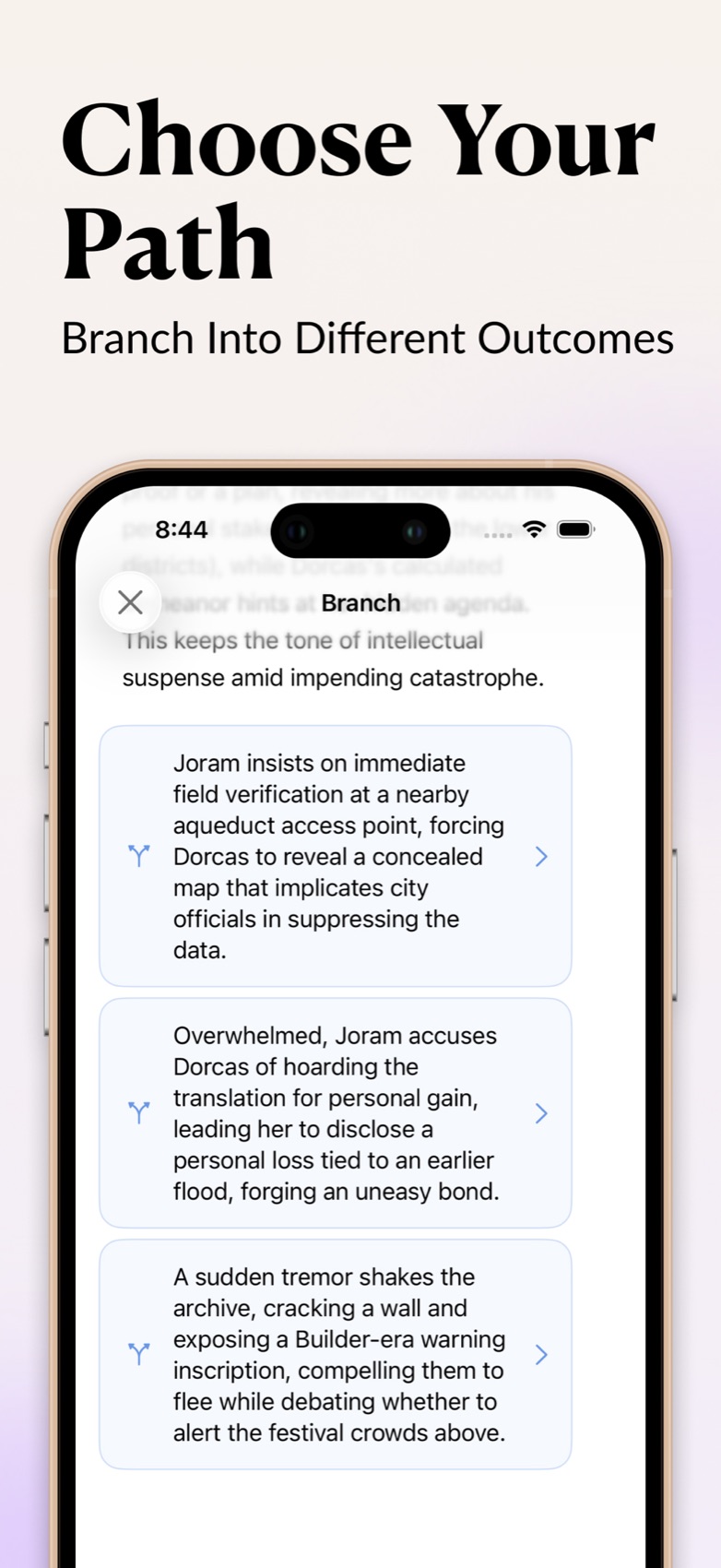
At that decision point, ask for a branch. InkPal returns three continuations of the current scene, each a paragraph or so, each taking the story somewhere different. In the screenshot above the archivist can insist on verifying the data in the field, accuse her colleague of hoarding it, or be interrupted by a tremor that exposes an old warning. Two of those are choices the character makes; the third is an event. Mixing the two kinds keeps the forks from feeling like a menu.
Read all three, then keep only the ones a reader could argue for. If two proposals are the same choice in different clothes, cut one and write your own. The AI's job at the fork is to widen the field of options; deciding which ones become paths stays with you.
Branch your next scene
InkPal keeps the story setup, plans chapters, branches scenes, and writes the mature paths other tools refuse. Free on iPhone.

Step 4: Follow one path to a stopping point, then return
Write one branch until it either reaches an ending or rejoins the trunk. Resist the urge to leave every path half-written; a fork with two finished paths is a story, a fork with six stubs is a to-do list. Give each branch its own chapter in the chapter planner and name it by the choice that led there ("She accuses Dorcas"), so you can find your way back to the fork without rereading.
Most detours should rejoin the trunk within a scene or two. Reserve full separate endings for the last fork or the one before it.
Step 5: Check consistency across paths
When the paths are written, read each one from the opening, start to finish. You are looking for facts that changed between branches: a character's eye colour, the name of the city, who knew what when. Every drift you find is also a missing line in the story setup, so add it there. Reading with narration on helps here; a listener notices when the archive is on the third floor in one path and underground in another.
Roleplay as a branching engine
If the branching you want is conversational rather than plotted, character chat is the faster tool. Set up a character with memory and limits, play the scene, and when it reaches a decision, go back a message and answer differently. Each run is a branch, and the transcript of the best one converts into prose the same way any roleplay session does. Writers of romance and dark fiction lean on this because the alternatives at a fork are often emotional rather than logistical, and a character who talks back surfaces them faster than a list.
Frequently asked questions
How many branches should an interactive story have?
Fewer than you think. Two or three choices at each fork, and four to six forks in a novella-length piece, is plenty. Doubling every time produces 64 endings by the sixth fork, and nobody can keep those consistent. Let most branches rejoin the trunk after a scene or two.
Can I write a branching story that is also adult or dark?
Yes, if your tool will write it. General assistants tend to refuse or soften mature branches, which quietly removes the most interesting choice at every fork. InkPal writes adult and dark fiction between fictional adults without refusals, so the branch you actually want stays on the table.
Related guides
Plan novel chapters with an AI chapter planner to hold each path in its own chapter. Turn your story into an audiobook to catch drift between paths by ear. Uncensored AI writing, explained, for why mature branches get refused elsewhere.